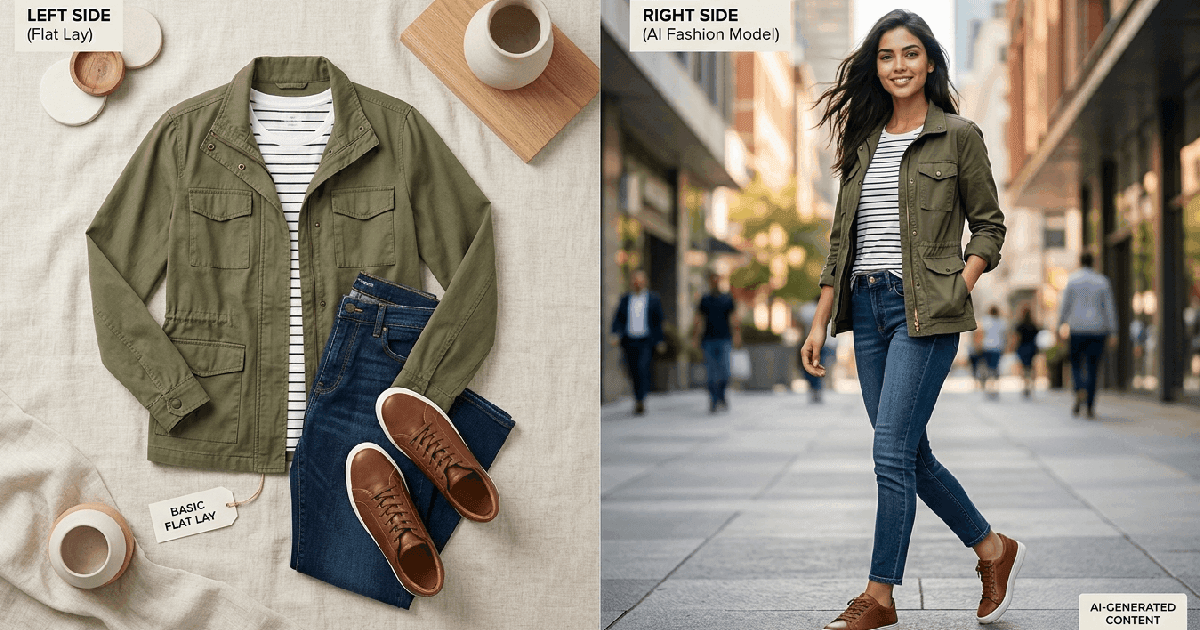
In the fiercely competitive e-commerce landscape of 2026, compelling visual content is no longer a luxury—it’s the baseline requirement for survival. Yet, for over a century, the method for producing these visuals remained largely unchanged: hire a photographer, rent a studio, buy props, ship products, and wait. Today, Artificial Intelligence has entirely disrupted this paradigm, introducing an alternative that promises unprecedented speed and scalability. But the question on every CFO’s and Marketing Director’s mind is: What is the actual bottom-line impact?
This comprehensive 2026 cost analysis breaks down the financial realities of AI vs. Traditional Product Photography. We’re moving past the hype and looking at hard numbers, hidden costs, return on investment (ROI), and real-world business examples to help you make the most profitable decision for your brand. Whether you run a boutique store or manage a massive catalog with thousands of SKUs, the insights here will fundamentally change how you plan your advertising budget.
Section 1: The Anatomy of Traditional Photography Costs
To understand the profound savings AI offers, we first need to dissect the true, often obscured cost of a traditional product photoshoot. Many brands only consider the photographer's day rate or hourly fee, completely ignoring the iceberg of logistical expenses hidden beneath the surface of the invoice. It's the compounding nature of these hidden fees that makes physical photoshoots unscalable for continuous content generation.
The Hidden Expenses of Physical Shoots
- Studio Rental: A professional studio with adequate lighting capabilities and seamless backgrounds typically costs ₹40,000 to ₹1,60,000 per day, depending on the tier of the city. High-end lifestyle sets (like renting an actual modern kitchen) can cost upwards of ₹2,50,000 a day.
- Photography Team: An experienced product photographer (₹60,000 - ₹2,00,000/day) is rarely working alone. You often need lighting assistants, stylists, and set designers to make the shot look organic and professional.
- Props and Set Building: If you want lifestyle shots (e.g., a coffee machine in a modern kitchen), you must either rent a location house or buy/rent expensive props. Fresh food, flowers, custom surfaces, and atmospheric elements add thousands to the bill quickly.
- Shipping and Handling: Physical products must be safely transported, insured, unpacked, styled, and sometimes discarded if damaged during the shoot (very common with food items or fragile goods). The logistics alone take a coordinator hours to manage.
- Post-Production/Retouching: Raw photos are almost never ready for publishing. They require extensive editing to remove dust, adjust colors perfectly to match the product, and composite elements. High-end retouching often costs ₹2,000 to ₹8,000+ per individual image.
- Time (The Ultimate Cost): A standard campaign shoot requires 2-4 weeks from concept to final delivery. In retail, lost time is lost revenue. Trends move fast, and waiting three weeks for a photo means missing out on potential viral moments.
When aggregated, a single campaign yielding 20 high-quality lifestyle images can easily cost a brand ₹4,00,000 to ₹12,00,000. When translating that to a per-image cost, you are often paying upwards of ₹40,000 per usable, retouched asset.
Section 2: The Economics of AI Product Photography
AI product photography completely flips this financial model on its head. By digitizing the entire production pipeline, it transforms massive capital expenditures into minimal, predictable operational costs. The studio is no longer a physical building; it is a server farm processing complex diffusion models.
How Costs are Fundamentally Restructured
- Software Subscriptions or API Costs: Instead of booking a ₹1,60,000 studio, you might pay a flat ₹1,100/month SaaS subscription or mere fractions of a rupee per API call. This democratizes access, allowing a one-person startup to generate photos that look like they belong in Vogue.
- No Physical Logistics or Material Waste: You only need one clear, basic photograph of your product (often taken on a smartphone). The AI generates the environment around it, eliminating shipping costs, prop acquisition, and set design. You no longer have to worry about buying fresh flowers just for them to wilt on set.
- Instant Iteration and Flexibility: Don't like the background? Changing it costs zero rupees and takes five seconds, compared to organizing a complete reshoot which could cost another ₹4,00,000. This low cost of failure encourages creative experimentation.
- Labor Shift: The role transitions from a physical production crew to a single "Prompt Engineer" or marketing manager who guides the AI software. The time spent shifts from physical exertion to creative direction.
The impressive result? Generating those same 20 high-quality lifestyle images using an AI platform typically costs between ₹80 and ₹400 in software/compute fees, taking mere hours instead of weeks. The barrier to entry for world-class branding has been effectively removed.
Section 3: Direct Cost Comparison Table
Let’s look at a standard business scenario: An e-commerce brand launching a new line of 10 products, requiring 3 lifestyle images per product (30 images total) for their website, social media, and advertising efforts. This is a very common requirement for a quarterly campaign.
| Expense Category | Traditional Photography Estimate | AI Photography Estimate |
|---|---|---|
| Studio / Location Rental | ₹1,00,000 (1 Day) | ₹0 |
| Photographer & Assistant | ₹2,00,000 (Day rate) | ₹0 |
| Stylist & Prop Budget | ₹65,000 | ₹0 |
| Product Shipping/Logistics | ₹12,000 | ₹0 |
| Retouching (30 Images) | ₹1,20,000 (₹4,000/image) | ₹0 |
| Software/AI Platform Costs | ₹0 | ₹1,100 (Monthly Sub) |
| In-House Labor (Marketing) | ₹30,000 (Logistics coordination) | ₹15,000 (Prompting/curation) |
| Total Campaign Cost | ₹5,27,000 | ₹16,100 |
| Cost Per Final Image | ₹17,566 | ₹536 |
| Turnaround Time | 2 - 3 Weeks | 1 Day |
The math is staggering and impossible to ignore. AI photography represents a 96% cost reduction while delivering assets exponentially faster. For any CFO plotting the yearly budget, these numbers signify a monumental shift in how marketing dollars should be allocated.
Section 4: The 2026 Interactive ROI Calculator Framework
Cost savings are only half the equation; Return on Investment (ROI) is driven by increased agility, A/B testing, and ultimately, sales performance. Because AI allows for endless variations of visual contexts (e.g., testing a product on a dark marble background vs. a sunny beach background), brands see significant lifts in click-through rates (CTR) and conversions when they utilize platforms efficiently.
You can use this mental framework to calculate your own potential ROI. To get the exact figures, input your company's data into the steps below.
Calculate Your Annual Visual ROI
1. Current Content Spend
- Average photo campaigns per year: (A) (e.g., 4)
- Average cost per traditional campaign: (B) (e.g., ₹6,40,000)
- Total Annual Cost: (A) x (B) (e.g., ₹25,60,000)
2. Projected AI Spend
- Estimated AI Software Cost: (C) (e.g., ₹13,200/yr)
- In-House Labor equivalent: (D) (e.g., ₹1,60,000/yr)
- Total Annual AI Cost: (C) + (D) (e.g., ₹1,73,200)
3. The Growth Factor
AI allows for hyper-personalized ad creative, which on average increases conversion rates by 15% to 30% due to more engaging, context-aware visuals.
- Current Annual E-commerce Revenue: (E) (e.g., ₹8,00,00,000)
- Projected Revenue Lift (Assume conservative 15%): (F) (e.g., ₹1,20,00,000)
- New Revenue: (E) + (F) (e.g., ₹9,20,00,000)
Total Impact Calculation:
Total ROI = Saved Costs ((A*B) - (C+D)) + Generated Revenue Lift (F)
Example Savings: ₹23,86,800 + ₹1,20,00,000 Growth = ₹1,43,86,800 Total Value Add
This projection demonstrates that transitioning to AI isn't just a cost-cutting measure; it is a revenue-generating strategy. The money saved on production overhead can be funneled directly back into ad spend or inventory, compounding your growth.
Section 5: Real Business Examples and Success Stories
Let's look beyond the theory and examine how actual brands are applying this technology to drive immense growth in 2026.
Case Study 1: "Lumina Botanicals" - D2C Skincare Brand
The Challenge: Lumina, an emerging startup skincare line, needed visually stunning lifestyle images for their Instagram ads and Shopify store to compete with established giants. However, their marketing budget was strictly limited to ₹1,60,000 for their highly anticipated quarterly launch.
The AI Solution: Instead of allocating their entire budget to a single day shoot, they shot their 5 serum bottles on stark white backgrounds using a standard iPhone ring light setup. They utilized an AI Product Photography generator to place the bottles in various high-end settings: resting on water ripples, surrounded by fresh aloe vera, and perched on premium bathroom vanities in natural light.
The Result: Zero rupees spent on photographers. They generated over 150 variations, ran dynamic Facebook ads to test which backgrounds their audiences preferred, and discovered that the "water splash" backgrounds yielded a 42% higher Click-Through Rate than the standard "bathroom vanity" shots. They achieved professional branding and data-driven ad optimization for a ₹1,100 monthly software fee, utilizing their ₹1,60,000 budget entirely for ad reach rather than asset creation.
Case Study 2: "Oak & Iron" - Boutique Furniture Retailer
The Challenge: Shipping a 300lb oak dining table to a photography studio, building a convincing fake "dining room" set around it, hiring movers, and shipping it back was wildly expensive—costing roughly ₹2,50,000 per new furniture piece just for photography.
The AI Solution: Oak & Iron integrated AI directly into their workflow. They now take standard warehouse shots of their furniture against a blank wall. The AI is prompted to place the table in a "Scandinavian minimalist apartment with large windows and morning sunlight," automatically generating realistic contact shadows, reflections on the wooden surfaces, and appropriate scale.
The Result: Photography costs plummeted by 85%. Furthermore, they used the technology to create "Seasonal Modifiers"—updating the background in November to feature a cozy fireplace and a Christmas tree in the corner. They kept their ad creatives entirely fresh for every season without physically moving a single heavy object ever again.
Section 6: When is Traditional Photography Still Relevant?
Despite the overwhelming cost benefits and agility of AI, traditional photography is not entirely obsolete. However, its role has fundamentally shifted. It has transitioned from a daily operational necessity to a premium, specialized tool reserved for highly specific instances.
- High-End Brand Anthems: For macro-level brand campaigns where deep human emotion, specific celebrity talent (who require bespoke lighting setups and directing), or highly complex physical interactions with the product are central to the narrative, traditional production remains king.
- Hyper-Specific Textures and Mechanics: While AI is incredible at creating realistic scenes, if your product's sole selling point is a microscopic, patent-pending fabric weave or a highly intricate mechanical watch movement that must be shown with 100% molecular accuracy, a macro-lens in a physical studio guarantees complete factual compliance without AI artifacts.
- Strict Legal & Compliance Industries: Certain industries—such as pharmaceuticals, highly regulated safety equipment, or legal documentation—may strictly require unedited, verifiable photographic proof of a product's state for advertising compliance to prevent claims of false advertising.
However, for 95% of e-commerce catalogs, day-to-day social media posts, email newsletters, and performance marketing assets, AI is now the undisputed, most sensible choice.
Section 7: The Future Integration of AI Photography
We are rapidly approaching an era of Dynamic Personalization at scale. Soon, an e-commerce website will use AI to alter the product’s lifestyle background in real-time based on the user's IP data, weather patterns, or browsing history. A shopper in currently snowy Chicago will see the winter coat featured in a majestic alpine setting, while a shopper in tropical Miami will see the exact same coat featured against a breezy coastal or urban backdrop—all generated on the fly as the page loads.
The companies that master prompt engineering and deep AI integration today are actively building the functional visual infrastructure required to win tomorrow’s highly personalized internet.
Conclusion: Stop Paying for Pixels, Start Investing in Growth
The cost analysis of 2026 is mathematically undeniable. Traditional product photography, when used for standard e-commerce operations and continuous content demand, is a fundamentally inefficient allocation of capital. By transitioning to an AI-driven visual production pipeline, companies are unlocking tens of thousands of dollars in their marketing budgets—capital that is being aggressively and strategically reinvested into inventory expansion, customer acquisition, and platform development.
Adaptation to this technology is no longer optional for brands seeking to scale; it is a critical financial imperative. The tools are widely available, the output quality is indistinguishable from reality, and the cost barrier has been entirely decimated. The time to switch is today.
Transform Your Visuals and Your Budget
Experience enterprise-grade visual production scaling without the enterprise costs. Stop wondering how your competitors are launching so many campaigns.
Start Creating with CodingMantra AIAbout the Author: CodingMantra Team
The CodingMantra Team consists of professional software developers, data scientists, and digital marketing experts dedicated to transforming e-commerce visual solutions.